

You have finalised the recipe, checked the ingredients, and approved the packaging. Then someone asks, “Is the label actually compliant for the UAE?” That is where things can get uncomfortable.
A missing detail, unclear allergen statement, incorrect claim, or poorly planned Arabic layout can send the artwork back for revision. Worse, the wrong adhesive or material can create problems after printing.
For food and beverage brands entering or growing in Dubai, a product label needs to be accurate, readable, and practical on the actual package.
What Information Must a Food Product Label Include in the UAE?
For prepackaged food, UAE.S 9:2019 sets the core labelling requirements. Related standards cover nutrition information and permitted nutrition and health claims. These standards form part of the UAE food sector’s mandatory technical framework.
For a buying team, the useful way to look at it is not as one giant compliance list. Think of the label as answering a few basic questions:
- What is this product? The product name should identify the food clearly.
- What is inside it? Ingredients and other applicable declarations need to be presented correctly.
- How much is here? The net quantity tells the buyer what they are actually purchasing.
- Who made, packed, imported, or is responsible for it? The applicable business details need to be identifiable.
- How should it be stored or used? Some products need specific storage or usage information.
- How long is it suitable for use? Date marking and related information depend on the food and applicable requirements.
- What does the nutrition panel say? Where nutrition labelling applies, S GSO 2233:2019 sets the relevant requirements.
For a brand preparing a product label, the important point is this: Do not design first and check compliance later. |
How Should Brands Handle Arabic and UAE-Specific Label Artwork?
For an imported product, the original packaging may not leave enough room for the required UAE information. Adding Arabic later can create crowded text, awkward layouts, or a label that simply does not fit the package.
So check this early:
- Arabic and English content
- Ingredient and allergen wording
- Nutrition panel layout
- Product and importer details
- Claims and supporting wording
- Available label area
Dubai Municipality provides food item registration and label assessment against applicable UAE and GCC requirements.
Sigma Labels can print the product label accurately. The product owner still needs to make sure the information itself is correct and compliant.
What Are the UAE Requirements for Ingredients, Allergens and Nutrition Information?
The ingredient declaration needs to follow the applicable UAE requirements. Nutrition information falls under UAE.S GSO 2233:2019.
For brands preparing a product label for the UAE market, the main checks include:
- Ingredients: Are they declared in the required manner?
- Allergens: Are relevant allergenic ingredients clearly identified?
- Nutrition data: Does the panel reflect the actual product formulation?
- Special claims: Does the wording match the supporting product data?
Dubai Municipality also provides laboratory testing for specific food-related claims, including gluten-related claims.
The point is simple: The recipe, technical data, and label must tell the same story.
Can You Put “Healthy”, “Natural” or “Sugar Free” on a UAE Food Label?
A brand may want to write “sugar free” across the front. Another may prefer “high protein” or “natural”. The question is not whether the phrase sounds good. It is whether the finished product meets the conditions attached to that claim.
The regular standard applies here as well. That means buying and brand teams should check the claim against the actual product before it reaches the product label.
What can go wrong?
- “Sugar free” may have specific compositional conditions.
- “Low fat” is not simply a statement about having less fat than another product.
- “High protein” needs the product to meet the applicable nutritional threshold.
- “Source of fibre” also depends on the product’s nutritional composition.
- “Natural” can create a different issue because the wording may imply something about ingredients or processing.
There is another common mistake. A claim approved for one SKU does not automatically work for every SKU in the range. Change the recipe. Change the serving basis. Change the formulation. The claim may need to be reviewed again. |
Do Food Labels Need Batch Numbers, Barcodes and Expiry Dates?
These details are easy to lump together. They serve very different purposes.
- A batch or lot number helps identify a particular production run. That matters when a brand needs to trace stock or investigate a quality issue.
- Date marking tells the buyer about the product’s shelf life. The exact requirement depends on the food and the applicable standard.
- A barcode serves a different purpose. It can identify the product through retail and registration systems. Dubai Municipality’s consumer product platform has also used product barcodes to help users verify registered products.
Then there is variable data.
That matters when different units or batches need different numbers, codes, or dates. Sigma Labels supports variable data printing and sequential numbering for product labels.
What Label Material Works Best for Food and Beverage Packaging?
The label can be perfectly printed and still fail on the package.
A chilled bottle creates condensation. A greasy container challenges the adhesive. A curved PET bottle can expose poor label flexibility.
Different packaging surfaces need different label constructions.
Packaging condition | What to consider |
Chilled bottles | Moisture and condensation resistance |
Glass jars | Adhesion and clean surface contact |
Plastic containers | Surface compatibility and flexibility |
Flexible pouches | Film flexibility and adhesive performance |
Oily products | Grease resistance and reliable adhesion |
Cold storage | Adhesive performance at low temperatures |
Outdoor or exposed products | Moisture, abrasion, UV, and durability |
Sigma Labels specifically advises choosing materials and adhesives based on the surface and operating environment. Its current product label service also highlights moisture-resistant solutions for food and beverage applications.
What Should Brands Check Before Sending a Food Label to Print?
Before releasing a product label for production, buying and brand teams should check:
- Final formulation: Does the artwork match the current recipe?
- Ingredients and allergens: Are the approved declarations being used?
- Claims: Has every nutrition or health claim been cleared?
- Dates and batch data: Are variable fields planned correctly?
- Barcode: Does the printed code scan properly?
- Arabic and English: Has the final bilingual artwork been checked?
- Label size: Will all required information remain readable at the actual print size?
- Material: Does it suit the bottle, pouch, jar, carton, or other pack?
- Adhesive: Will it hold through refrigeration, moisture, oils, or handling?
- Proof: Has someone checked the physical output before the full run?
Why Brands Choose Sigma Labels for Food and Beverage Labels?
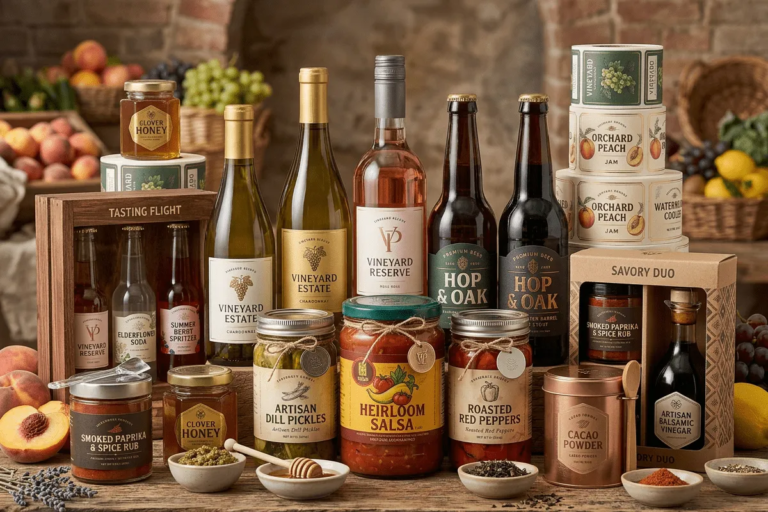
Sigma Label’s UAE product label service covers food and beverage applications with food-safe inks, durable materials, and moisture-resistant options. It also carries out adhesion and colour accuracy checks.
That gives brands some useful production flexibility:
- Digital and flexographic printing for different production requirements.
- Variable data printing for serialised barcodes and changing label information.
- Custom shapes and sizes for different packaging formats.
- Material and adhesive selection based on the package surface and operating conditions.
- QR code integration when a brand needs digital product information or authentication.
- Food-focused label materials designed to handle moisture and everyday handling.
The useful part is not simply having more printing options. It is getting the label construction to match the product.
Got a product to label? Let Sigma Labels make sure the label is ready for the real world.
Frequently Asked Questions
It depends on size, material, quantity, printing method, and finishing. Sigma Labels can quote the specification rather than a generic per-label price.
Short runs are possible. Sigma Labels has reported handling digital jobs from around 500 to 600 labels.
Yes. Variable data printing can place different batch details, barcodes, or identifiers across the same production run.
Yes. Sigma Label’s newer Epson SurePress installation supports clear, metallic, and coloured substrates with variable data and white ink capability.
It depends on quantity and complexity. Digital suits shorter or variable runs, while flexography is well suited to larger repeat production.
Yes. Digital variable data capability makes changing artwork or product information across short runs practical.
Its digital production setup was specifically introduced to make shorter jobs viable and improve turnaround for lower quantity orders.
Yes. Sigma Labels supports variable data printing for barcodes and QR-based applications.
Yes. Its Epson SurePress L 6534VW supports high-opacity white ink, including work on clear and metallic substrates.
Digital production makes short runs practical, which can be useful for testing artwork, materials, or new SKUs before larger production.